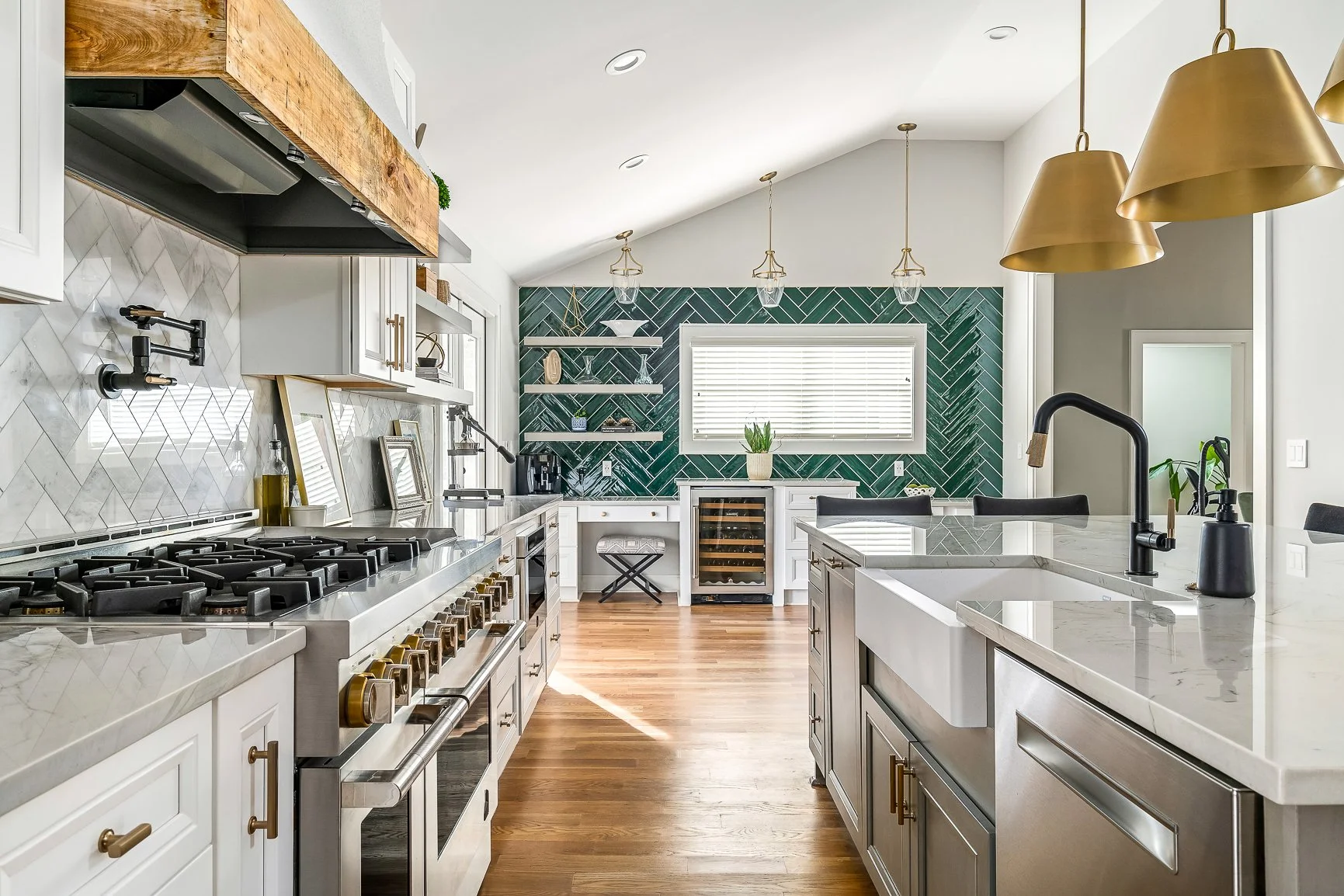
Pièce de Rèsistance

In these articles, we often highlight how residential design has evolved over the past few decades and which areas of the home have seen the most amazing changes in design and material options. It is hard to pick one facet of a home renovation design to say that it has seen the most dramatic change, but certainly the kitchen backsplash bids fair to take the title.

It’s hard to remember the last time we installed the old standard — 4” of the countertop material standing up against the wall. The backsplash has truly become the pièce de rèsistance of kitchen design — the artistic flair that changes the look of a finished kitchen in an instant. But this facet of kitchen design has evolved no less than cabinetry and countertops, and the available options in materials and design are almost limitless.

When we made the momentous shift from Formica to Ubatuba granite, we were thrilled with the extra 4” of granite along the back the counters. But then subway tile became the rage, and some even installed it on top of the granite backsplash (horrors!). Then the subway tile evolved into beveled edge, then long and thin, then cracked stone and vertical chevrons, and finally the Walker Zanger collection moved our kitchens into a whole new style dimension (and the same for our budget).

But tile is not the only material available for the backsplash. Carrying the countertop quartz up the wall to the wall cabinets or countertop hood provides a clean and smooth look that is both modern and timeless. We can even put your old wine corks to re-use as a cork backsplash at your wine bar! Give us a call today to start the style evolution conversation for your next kitchen remodel.

Deborah HartmanComment
Product Review: Aquor Water Systems

Why do we love Aquor Water Systems products? Because the low profile faucet provides freeze protection while offering sharp modern lines or low visual impact.

A faucet should be located at each of the active spaces around the exterior of your home. But this often means a utility fixture is highly visible as your family gathers on the porch, pool deck, or grill station. Depending on which model you chose, you can align these Aquor fixtures with a modern home’s aesthetic or you can virtually hide the “hose-bib” entirely. The V2 with its square shape and color options is cutting edge for hose-bib technology and looks. At the same time the V1 with its low profile round shape can blend in anywhere and lets a traditional space shine.

In the upstate of South Carolina overnight freezes are a common occurrence and in the past decade deeper freezes have occurred each winter. If you are like us, when the forecast calls for overnight freeze you are busy worrying about your outdoor plants and not considering your hose-bibs. The cold weather impact is even greater for homeowners in Western North Carolina! In the past, homes often shed heat energy from the walls and floors which would keep the pipes and hose-bibs warm. As AJH strives to build homes tighter and exceed code minimums, installing spray foam wall assemblies or external insulation it has become more important to install a fixture that places the valve and water piping deeper inside the home’s envelope to keep it on the “warm side” of the shell … Aquor Water Systems does this so you don’t have to worry about it again.

Check out the V1 here: https://www.aquorwatersystems.com/products/house-hydrant-v1-plus

And the V2 here:  https://www.aquorwatersystems.com/products/house-hydrant-v2-plus-matte-black-stainless-steel

Also for a yard hydrant you can mow over instead of trimming around check out the ground hydrant: https://www.aquorwatersystems.com/products/ground-hydrant

April Fool’s Day – Twenty Years On

April 1, 2005 is the incorporation date of AJH Renovations, LLC, the first of the AJH family of companies to be born. No foolin’; it’s been twenty years since this show had its first episode, a whole-house renovation on North Main Street in downtown Greenville. Over the past two decades, we’ve lost count of how many residential renovations we have done in and around Greenville. Along the way, we added two divisions to our family – AJH Custom Homes, LLC, and Designed for Downtown, LLC. We have also branched out into light commercial and commercial subcontract work, including a key role in the recent ballroom renovation at the Pointsett Club in downtown Greenville. Each year has brought new opportunities and new challenges, not least of which were the Great Recession of 2009, the COVID pandemic, and the current high mortgage rates and general economic uncertainty. These challenges motivated us to develop a design/build renovation system that is both creative and efficient, providing our clients with beautiful and effective revitalization of their older homes.

Soon after the incorporation of AJH Renovations, LLC, we realized the need for a design division. Our clients needed detailed drawings to properly plan and envision their upcoming renovations. Eventually we incorporated as Designed for Downtown, specializing in custom home design, renovation & addition design planning, landscape design, and interior design work. What sets us apart from other designers is our experience working in the field alongside contractors and builders from permitting to final interior painting.

AJH Renovations, LLC is one of the pioneers in the Upstate of the Design/Build renovation model combining in-house architectural design with licensed construction services. This model streamlines the process of taking the homeowners’ dreams and needs and turning them into reality while also maintaining the character and ambiance of the mature home. Our designers work with our construction management staff in order to propose renovations that ‘work’ with the house or, as we often put it, letting the house work with the renovation. Design modifications can be investigated with the cost impact immediately determined by the construction side of the business. Proposed modifications are evaluated from the aesthetic and functional aspect, but also from the perspective of ‘buildability’ and code compliance. Our clients have been overwhelmingly pleased and well-served by the Design/Build model.

We at the AJH Family – AJH Renovations, AJH Custom Homes, and Designed for Downtown, bring twenty years of residential design and construction experience to the table. Give us a call today to see how our Design/Build model can transform your house into a ‘new’ old home.

Deborah HartmanComment
Plan for the Future

Gerard Mercator is a name you might not be able to recall from Middle School Social Studies, but he is the 16th Century Flemish mathematician and cartographer who famously figured out how to display a 3-dimensional world on a 2-dimensional map – the Mercator Projection. Mercator himself was somewhat of a rags-to-almost-riches story (it wasn’t easy to become rich making maps) and was considered the Prince of Cartographers in his own day even though he never traveled on a ship.

As Mercator gained some success at his trade, he was finally able to contemplate building a house for his growing family, and here his story is a lot like many of ours: budget for the necessities and plan for the future. He contracted for the design and construction of a ‘comfortable and grand dwelling suitable for an honest citizen of modest fortune.’

His was not an unlimited fortune, though, so the minimum requirements were set as ‘the essentials for maintaining the household…such as a kitchen, a store for food, bedrooms, cisterns…’ Mercator had reason to hope that his fortune would continue to grow, so he laid in provision for ‘entertaining, the amenities of life, ornament, and magnificence such as porticos, halls, courts, dining rooms, a third floor, pleasure gardens, and orchards could be added as time passes and opportunity and convenience arise.’ We can assume that ‘opportunity and convenience’ meant more money!

Mercator was planning ahead, and contracted that the ‘plan of the whole work be drawn up at first.’ We call this a Master Plan, and Designed for Downtown understands that budgets are today what they were in Mercator’s day – rarely able to absorb the whole picture in one view. But it is still important to plan for the future and to leave room for additions and improvements to accommodate ‘the amenities of life’ as ‘opportunity and convenience’ allow. Give Design for Downtown a call to start planning the present essentials and the future additions now for your home renovation or custom home.

Deborah HartmanComment